Mensuration-SolutionsEx-10.3
CBSE Class –VI Mathematics
NCERT Solutions
Chaper 10 Mensuration (Ex. 10.3)
NCERT Solutions
Chaper 10 Mensuration (Ex. 10.3)
Question 1. Find the areas of the rectangles whose sides are:
(a) 3 cm and 4 cm
(b) 12 m and 21 m
(c) 2 km and 3 km
(d) 2 m and 70 cm
(b) 12 m and 21 m
(c) 2 km and 3 km
(d) 2 m and 70 cm
Answer: (a) Area of rectangle = length x breadth
= 3 cm x 4 cm = 12 cm2
= 3 cm x 4 cm = 12 cm2
(b) Area of rectangle = length x breadth
= 12 m x 21 m = 252 m2
= 12 m x 21 m = 252 m2
(c) Area of rectangle = length x breadth
= 2 km x 3 km = 6 km2
= 2 km x 3 km = 6 km2
(d) Area of rectangle = length x breadth
= 2 m x 70 cm = 2 m x 0.7 m = 1.4 m2
= 2 m x 70 cm = 2 m x 0.7 m = 1.4 m2
Question 2. Find the areas of the squares whose sides are:
(a) 10 cm (b) 14 cm (c) 5 m
(a) 10 cm (b) 14 cm (c) 5 m
Answer:(a) Area of square = side x side = 10 cm x 10 cm = 100 cm2
(b) Area of square = side x side = 14 cm x 14 cm = 196 cm2
(c) Area of square = side x side = 5 m x 5 m = 25 m2
(c) Area of square = side x side = 5 m x 5 m = 25 m2
Question 3. The length and the breadth of three rectangles are as given below:
(a) 9 m and 6 m
(b) 17 m and 3 m
(c) 4 m and 14 m
Which one has the largest area and which one has the smallest?
(b) 17 m and 3 m
(c) 4 m and 14 m
Which one has the largest area and which one has the smallest?
Answer: (a) Area of rectangle = length x breadth = 9 m x 6 m = 54 m2
(b) Area of rectangle = length x breadth= 3 m x 17 m = 51 m2
(c) Area of rectangle = length x breadth= 4 m x 14 m = 56 m2
(c) Area of rectangle = length x breadth= 4 m x 14 m = 56 m2
Thus, the rectangle (c) has largest area, i.e. 56 m2 and rectangle (b) has smallest area, i.e., 51 m2.
Question 4. The area of a rectangular garden 50 m long is 300 m2, find the width of the garden.
Answer: Length of rectangle = 50 m and Area of rectangle = 300 m2
Since, Area of rectangle = length x breadth
Therefore, Breadth = = 6 m
Thus, the breadth of the garden is 6 m.
Question 5. What is the cost of tiling a rectangular plot of land 500 m long and 200 m wide at the rate of Rs. 8 per hundred sq. m?
Answer: Length of land = 500 m and Breadth of land = 200 m
Area of land = length x breadth = 500 m x 200 m = 1,00,000 m2
Cost of tiling 100 sq. m of land = Rs. 8
Cost of tilling 1,00,000 sq. m of land = = Rs. 8000
Question 6. A table-top measures 2 m by 1 m 50 cm. What is its area in square meters?
Answer: Length of table = 2 m and breadth of table = 1 m 50 cm = 1.50 m
Area of table = length x breadth
= 2 m x 1.50 m = 3 m2
= 2 m x 1.50 m = 3 m2
Question 7. A room is 4 m long and 3 m 50 cm wide. How many square meters of carpet is needed to cover the floor of the room?
Answer: Length of room = 4 m and breadth of room = 3 m 50 cm = 3.50 m
Area of carpet = length x breadth
= 4 x 3.50 = 14m2
Therefore, 14m2 of carpet required to cover the floor.
= 4 x 3.50 = 14m2
Therefore, 14m2 of carpet required to cover the floor.
Question 8. A floor is 5 m long and 4 m wide. A square carpet of sides 3 m is laid on the floor. Find the area of the floor that is not carpeted.
Answer: Length of floor = 5 m and breadth of floor = 4 m
Area of floor = length x breadth
= 5 m x 4 m = 20 m2
Now, Side of square carpet = 3 m
Area of square carpet = side x side = 3 x 3 = 9 m2
= 5 m x 4 m = 20 m2
Now, Side of square carpet = 3 m
Area of square carpet = side x side = 3 x 3 = 9 m2
Area of floor that is not carpeted = 20 m2 – 9 m2 = 11 m2
Question 9. Five square flower beds each of sides 1 m are dug on a piece of land 5 m long and 4 m wide. What is the area of the remaining part of the land?
Answer: Side of square bed = 1 m
Area of square bed = side x side = 1 m x 1 m = 1 m2
Area of 5 square beds = 1 x 5 = 5 m2
Now, Length of land = 5 m and breadth of land = 4 m
Area of land = length x breadth = 5 m x 4 m = 20 m2
Area of remaining part = Area of land – Area of 5 flower beds
= 20 m2 – 5 m2 = 15 m2
Question 10. By splitting the following figures into rectangles, find their areas. (The measures are given in centimeters)
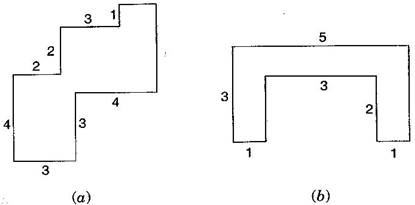
Answer: (a) The given figure can be broken into rectangles as follows.
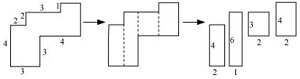
Area of 1st rectangle = 4 x 2 = 8 cm2
Area of 2nd rectangle = 6 x 1 = 6 cm2
Area of 3rd rectangle = 3 x 2 = 6 cm2
Area of 4th rectangle = 4 x 2 = 8cm2
Total area of the figure = 8 + 6 + 6 + 8 = 28 cm2
Area of 2nd rectangle = 6 x 1 = 6 cm2
Area of 3rd rectangle = 3 x 2 = 6 cm2
Area of 4th rectangle = 4 x 2 = 8cm2
Total area of the figure = 8 + 6 + 6 + 8 = 28 cm2
(b) The given figure can be broken into rectangles as follows.
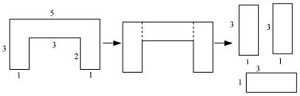
Area of 1st rectangle = 3 x 1 = 3 cm2
Area of 2nd rectangle = 3 x 1 = 3 cm2
Area of 3rd rectangle = 3 x 1 = 3 cm2
Total area of the figure = 3 + 3 + 3 = 9 cm2
Area of 2nd rectangle = 3 x 1 = 3 cm2
Area of 3rd rectangle = 3 x 1 = 3 cm2
Total area of the figure = 3 + 3 + 3 = 9 cm2
Question 11. Split the following shapes into rectangles and find their areas. (The measures are given in centimeters)
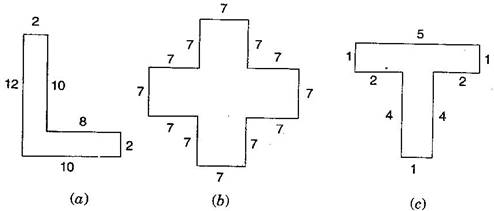
Answer: (a) The given figure can be broken into rectangles as
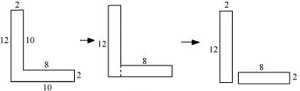
Area of 1st rectangle = 12 x 2 = 24 cm2
Area of 2nd rectangle = 8 x 2 = 16 cm2
Total area of the figure = 24 + 16 = 40 cm2
(b) The given figure can be broken into rectangles as follow
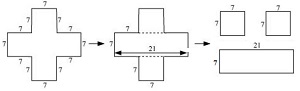
Area of 1st rectangle = 21 x 7 = 147 cm2
Area of 1st square = 7 x 7 = 49 cm2
Area of 2nd square = 7 x 7 = 49 cm2
Total area of the figure = 147 + 49 + 49 = 245 cm2
(c) The given figure can be broken into rectangles as follow
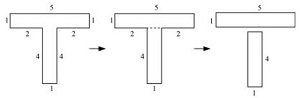
Area of 1st rectangle = 5 x 1 = 5 cm2
Area of 2nd rectangle = 4 x 1 = 4 cm2
Total area of the figure = 5 + 4 = 9 cm2
Question 12. How many tiles whose length and breadth are 12 cm and 5 cm respectively will be needed to fit in a rectangular region whose length and breadth are respectively:
(a)100 cm and 144 cm
(b)70 cm and 36 cm
(b)70 cm and 36 cm
Answer:
(a) Area of region = 100 cm x 144 cm = 14400 cm2
Area of one tile = 5 cm x 12 cm = 60 cm2
Area of one tile = 5 cm x 12 cm = 60 cm2
Number of tiles = = 240
Thus, 240 tiles are required.
(b) Area of region = 70 cm x 36 cm = 2520 cm2
Area of one tile = 5 cm x 12 cm = 60 cm2
Area of one tile = 5 cm x 12 cm = 60 cm2
Number of tiles = = 42
Thus, 42 tiles are required.
Thus, 42 tiles are required.